Workflow for Amazon sales growth: optimize your 2026 strategy
Autor: Agile Consultancy Team | Categorie: Blog | Timp de citire: 12 min

Managing Amazon sales growth feels like juggling flaming torches while riding a unicycle. You’re balancing inventory levels, tweaking PPC campaigns, protecting your brand from hijackers, and trying to decipher algorithm changes that seemingly happen overnight. Most sellers find themselves reacting to problems rather than preventing them, which drains time and money. A structured workflow changes everything by transforming chaotic firefighting into predictable, scalable growth. This guide walks you through building and executing a complete Amazon sales growth workflow optimized for the competitive landscape of 2026, giving you the framework to maximize results while minimizing wasted effort.
Table of Contents
- Preparing Your Amazon Sales Growth Workflow
- Executing The Workflow: Step By Step To Sales Growth
- Verifying And Optimizing Your Amazon Sales Workflow
- Optimize Your Amazon Sales Growth With Expert Services
- Frequently Asked Questions
Key takeaways
| Point | Details |
|---|---|
| Structured workflow essential | A clear workflow streamlines Amazon sales growth by organizing tasks and eliminating reactive chaos |
| Preparation sets foundation | Defining goals, understanding your market, and selecting integrated tools creates a strong starting point |
| Execution drives results | Systematic inventory management, PPC optimization, and brand protection directly impact sales performance |
| Verification enables improvement | Tracking metrics and troubleshooting issues allows data-driven adjustments for sustained growth |
| Brand protection prevents losses | Proactive monitoring deters counterfeiters and hijackers, preserving customer trust and revenue |
Preparing your Amazon sales growth workflow
Before diving into execution, you need a solid foundation. Preparation separates sellers who stumble through trial and error from those who scale efficiently. Start by defining specific sales targets for 2026, whether that’s a 40% revenue increase, expanding into three new product categories, or reducing your advertising cost of sale (ACoS) to under 20%. Vague goals like “grow more” won’t cut it because you can’t measure progress or adjust tactics without concrete benchmarks.
Next, conduct thorough competitor and market research tailored to your product niche. Analyze top-performing listings in your category to understand what keywords they rank for, how they structure their bullet points, and what price points dominate. Use tools like Helium 10 or Jungle Scout to identify search volume trends and seasonal patterns specific to your products. This research reveals gaps in the market you can exploit and helps you set realistic expectations for growth velocity based on actual market conditions rather than wishful thinking.
Assembling the right toolkit makes or breaks your workflow efficiency. You need software that handles inventory forecasting, PPC automation, listing optimization, and brand monitoring without requiring you to log into five different platforms daily. Look for solutions that integrate multiple functions and provide centralized dashboards where you can spot issues at a glance.
| Tool Category | Primary Function | Integration Benefit | | — | — | | Inventory Management | Forecasts stock needs and prevents stockouts | Syncs with sales velocity to automate reorder points | | PPC Automation | Optimizes bids and budgets across campaigns | Adjusts spending based on real-time performance data | | Listing Optimization | Enhances SEO and conversion elements | Tracks keyword rankings and suggests improvements | | Brand Protection | Monitors for hijackers and counterfeits | Alerts you to unauthorized sellers within hours |
Understanding Amazon policy updates for 2026 is critical because rule changes can torpedo your entire strategy overnight. Recent updates around review solicitation, variation listings, and advertising policies require immediate attention. Subscribe to Amazon’s seller newsletters and join active seller communities where policy changes get discussed in real time. Missing a policy shift could result in listing suspensions or account restrictions that halt your growth momentum completely.
Pro Tip: Choose software platforms that offer multi-function capabilities rather than best-of-breed point solutions. The time you save by avoiding constant platform switching and manual data transfers compounds into hundreds of hours annually that you can redirect toward strategic planning and product development.
Executing the workflow: step by step to sales growth
With preparation complete, you’re ready to execute the workflow that drives consistent sales growth. This systematic approach ensures nothing falls through the cracks while maximizing your efficiency across all critical Amazon selling functions.
Step one involves maintaining optimal inventory levels to avoid the twin disasters of stockouts and excess stock. Stockouts kill your search ranking momentum and hand customers to competitors, while excess inventory ties up capital and incurs long-term storage fees. Use your inventory management software to calculate reorder points based on sales velocity, lead times, and seasonal fluctuations. Set automated alerts that notify you when stock levels drop below your safety threshold, typically enough inventory to cover lead time plus two weeks of buffer. Factor in Amazon’s receiving delays, which can add 7-10 days to your planning timeline during peak seasons.

Step two focuses on launching and continuously refining PPC campaigns. Start with automatic campaigns to gather keyword data, then graduate to manual campaigns targeting your highest-converting search terms. Monitor your ACoS daily during the first two weeks of any new campaign, as this initial period determines whether you’re burning money or building profitable momentum. Successful sellers reduce ACoS by 30% through systematic bid adjustments and negative keyword refinement. Allocate 60% of your ad budget to proven winners and 40% to testing new keywords and product targeting opportunities.
Step three enhances product listings with SEO-optimized elements that convert browsers into buyers. Your title should front-load the most important keywords while remaining readable to humans, not keyword-stuffed gibberish. Bullet points must address customer pain points and highlight specific benefits rather than generic features. Images need to showcase your product from multiple angles, demonstrate use cases, and include infographics that communicate key differentiators at a glance. A/B test different main images because a 2% conversion rate improvement translates to thousands of dollars in additional revenue at scale.
Step four implements brand protection measures that prevent hijackers and counterfeiters from stealing your sales and damaging your reputation. Enroll in Amazon Brand Registry if you haven’t already, as this unlocks powerful tools for reporting violations and controlling your brand presence. Set up automated monitoring that scans your listings daily for unauthorized sellers, and establish a response protocol for filing complaints immediately when violations occur. Every day a hijacker remains on your listing costs you money and erodes customer trust.
Common mistakes that sabotage execution include neglecting regular campaign reviews, ignoring customer feedback patterns, failing to update listings based on seasonal trends, underestimating lead times for inventory replenishment, and treating brand protection as optional rather than essential. Each mistake compounds over time, turning small problems into major revenue losses.
Pro Tip: Schedule a weekly workflow review every Monday morning where you examine the previous week’s metrics and identify any anomalies requiring immediate attention. This 30-minute investment catches issues while they’re still manageable rather than after they’ve caused significant damage to your sales performance.
Verifying and optimizing your Amazon sales workflow
Execution without verification is like driving blindfolded. You need systematic processes for tracking progress, identifying problems, and making data-driven adjustments that compound into sustained growth over time. The verification phase transforms your workflow from a static checklist into a dynamic system that evolves with market conditions and performance data.
Start by establishing which metrics actually matter for your business goals. Vanity metrics like total impressions might look impressive but mean nothing if they don’t translate into profitable sales. Focus on conversion rate, click-through rate, ACoS, return on ad spend (ROAS), and organic ranking position for your target keywords. Track these metrics weekly and compare them against your baseline to spot trends before they become crises.
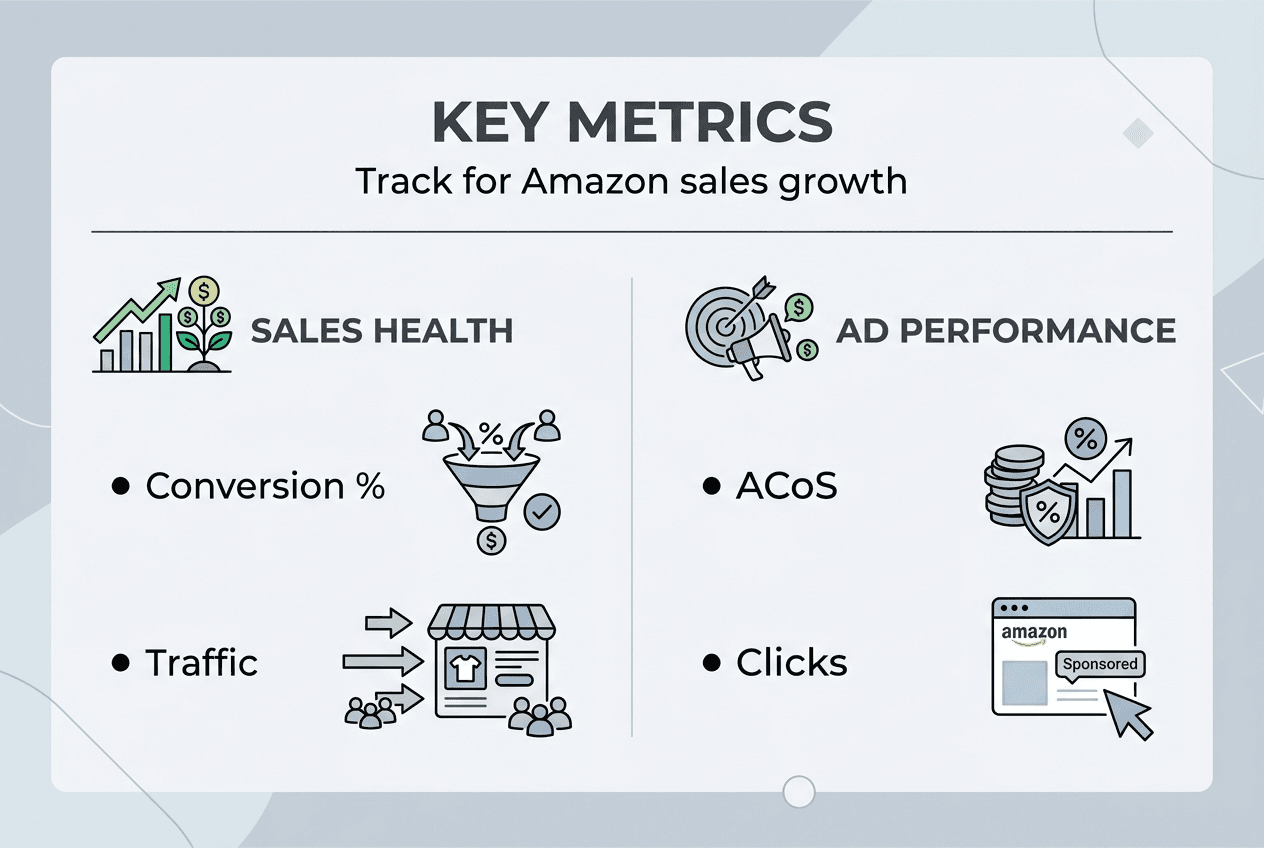
| Metric | Healthy Range | Red Flag Threshold | Action Required | | — | — | — | | Conversion Rate | 12-18% | Below 10% | Review listing elements and pricing | | Click-Through Rate | 0.4-0.6% | Below 0.3% | Optimize main image and title | | ACoS | 15-25% | Above 35% | Pause underperforming keywords | | Organic Rank | Top 20 | Drops below 50 | Increase review velocity and optimize backend keywords |
Identifying red flags requires knowing what normal looks like for your products. Sudden traffic drops often signal that a competitor launched an aggressive promotion or that your organic ranking slipped due to inventory issues. Conversion rate decreases might indicate that negative reviews accumulated or that your pricing became uncompetitive. ACoS spikes usually mean your campaigns are targeting low-intent keywords or that your bids need adjustment based on competition changes.
Troubleshooting common workflow pitfalls involves systematic diagnosis rather than panicked reactions. When sales decline, check inventory levels first because stockouts tank your ranking even after inventory returns. Next, review your advertising campaigns for budget exhaustion or paused ads. Then examine your listing for hijackers or suppressed content. Finally, analyze external factors like seasonal trends or new competitor entries. This sequential approach prevents you from making hasty changes that create new problems while leaving the root cause unaddressed.
Adapting your strategy based on data separates growing sellers from stagnant ones. If certain keywords consistently deliver low ACoS and high conversion rates, shift more budget toward them even if conventional wisdom suggests they’re too competitive. If specific product variations underperform despite optimization efforts, consider discontinuing them to focus resources on winners. If customer reviews repeatedly mention the same complaint, address it in your next inventory order rather than hoping the problem resolves itself.
Feedback loops refine your PPC and listing strategies through continuous testing and iteration. Run A/B tests on main images every quarter, as customer preferences shift with trends and seasons. Test different bullet point structures to see whether feature-focused or benefit-focused copy converts better for your audience. Experiment with bid strategies, moving from manual to automated bidding once you’ve gathered sufficient performance data. Continuous monitoring and adjustment of workflow components are key to sustained growth because Amazon’s marketplace never stands still.
The most successful sellers treat their workflow as a living document that evolves based on results rather than a rigid set of rules that must be followed regardless of outcomes. When something stops working, they investigate why and adapt rather than doubling down on failing tactics out of stubbornness or inertia.
Optimize your Amazon sales growth with expert services
Building and executing an effective Amazon sales workflow requires deep platform knowledge, specialized tools, and constant attention to detail. While this guide provides the framework, implementing it successfully while running your business can stretch your resources thin. That’s where expert guidance accelerates results and prevents costly mistakes that eat into your profit margins.

Agile Consultancy specializes in helping Amazon sellers build workflows that deliver measurable growth without overwhelming your team. Our comprehensive services include full account management, data-driven PPC optimization, and proactive brand protection monitoring. We’ve helped sellers reduce ACoS by 30% while increasing sales velocity through systematic workflow optimization. Whether you need a complete account audit to identify gaps in your current approach or ongoing management to execute your growth strategy, our team brings the expertise and tools to maximize your Amazon potential in 2026’s competitive marketplace.
Frequently asked questions
What are the essential tools for managing an Amazon sales growth workflow?
The most critical tools include inventory management software that forecasts stock needs based on sales velocity, PPC automation platforms that optimize bids and budgets across campaigns, listing optimization tools that track keyword rankings and suggest improvements, and brand protection services that monitor for unauthorized sellers. Integration between these tools enhances workflow efficiency by eliminating manual data transfers and providing centralized dashboards where you can spot issues immediately. Many successful sellers use comprehensive management software that combines multiple functions rather than juggling separate point solutions that don’t communicate with each other.
How often should I review and adjust my Amazon sales growth workflow?
Weekly reviews catch issues early and enable agile adjustments before small problems become major revenue losses. Dedicate 30 minutes every Monday to examine the previous week’s metrics, identify anomalies, and adjust tactics accordingly. Monthly deeper analysis supports strategic planning by revealing longer-term trends that weekly snapshots might miss. During these monthly reviews, evaluate whether your workflow processes still align with your growth goals or whether you need to restructure your approach based on market changes and performance data.
What common mistakes should I avoid when executing my Amazon sales workflow?
Ignoring inventory levels leads to stockouts that destroy your organic ranking momentum and hand sales to competitors. Neglecting PPC monitoring allows underperforming campaigns to burn through your budget without delivering results. Poor brand protection enforcement lets hijackers and counterfeiters steal your sales while damaging your reputation with inferior products. Treating your workflow as a static checklist rather than a dynamic system prevents you from adapting to market changes. Consistent process adherence and regular reviews mitigate these risks by catching problems while they’re still manageable rather than after they’ve caused significant damage.
Why is brand protection critical in a sales growth workflow on Amazon?
Protecting your brand deters counterfeiters and hijackers who undercut your pricing with inferior products, stealing sales while damaging your reputation with poor quality and customer service. Every day an unauthorized seller remains on your listing costs you revenue and erodes the customer trust you’ve built through quality products and reliable fulfillment. Brand protection processes ensure sustainable sales growth by maintaining pricing integrity and product quality standards. Enrolling in Amazon Brand Registry and implementing automated monitoring catches violations within hours rather than weeks, allowing you to respond quickly before significant damage occurs to your sales velocity and customer perception.