What is organic growth on Amazon: strategy guide 2026
Autor: Agile Consultancy Team | Categorie: Blog | Timp de citire: 11 min

Many Amazon sellers believe organic growth simply means ranking for the right keywords. They spend countless hours optimizing backend search terms while their conversion rates stagnate and click-through rates remain invisible. Real organic growth on Amazon in 2026 depends on behavioral signals like conversion rate and CTR, not just keyword placement. Understanding how Amazon’s A10 algorithm weighs sales performance, customer engagement, and seller authority helps you increase product visibility and sales while minimizing advertising costs. This guide reveals what truly drives organic rankings and how to leverage these insights for sustainable growth.
Table of Contents
- Understanding Organic Growth On Amazon’s Platform In 2026
- How Conversion Rate And Click-Through Rate Affect Your Amazon Organic Rankings
- The Amazon A10 Algorithm And Its Impact On Organic Growth Strategies
- Practical Strategies To Drive Organic Growth And Minimize Advertising Costs
- Grow Your Amazon Business With Expert Support
- Frequently Asked Questions
Key takeaways
| Point | Details |
|---|---|
| Conversion signals dominate | Amazon’s A10 algorithm prioritizes conversion rate and click-through rate over keyword density when determining organic rankings. |
| Behavioral metrics matter most | Product images, pricing, reviews, and customer engagement signals drive visibility more than backend search term optimization alone. |
| External traffic boosts authority | Driving off-Amazon traffic and building seller reputation significantly improve organic rankings under the current algorithm. |
| Holistic optimization required | Sustainable organic growth requires balancing listing quality, external marketing, customer service, and strategic keyword placement. |
Understanding organic growth on Amazon’s platform in 2026
Organic growth means improving your product’s sales and visibility without relying on paid advertising. When your listing climbs search results naturally and generates more orders from unpaid traffic, you’re experiencing organic growth. This approach reduces your advertising cost of sales (ACOS) while building sustainable momentum that compounds over time.
Amazon’s A10 algorithm has fundamentally shifted how products earn visibility. Unlike earlier versions that heavily weighted keyword matching, A10 emphasizes behavioral signals that indicate genuine customer interest and satisfaction. The algorithm interprets how shoppers interact with your listing as proof of relevance and quality.
Conversion rate is the strongest ranking factor in 2026. When a higher percentage of visitors purchase your product, Amazon interprets this as a signal that your listing delivers what customers want. A product converting at 12% will consistently outrank a competitor converting at 7%, even if the lower-performing listing has better keyword optimization.
Click-through rate from search results serves as another critical signal. When shoppers consistently click your listing over competitors in search results, Amazon recognizes your product as more relevant for that query. This behavioral data tells the algorithm your listing resonates with customer intent better than alternatives.
Several interconnected signals influence your organic ranking:
- Product image quality and relevance to search intent
- Price competitiveness within your category
- Review ratings and quantity
- Seller authority and account health
- Sales velocity and momentum
- External traffic sources
“The main driver of organic rank on Amazon is conversion rate. Everything else supports or detracts from this core metric. Sellers who obsess over keywords while ignoring conversion optimization are fighting yesterday’s battle.”
Focusing exclusively on keyword stuffing neglects what truly drives ranking in 2026. While relevant keywords remain important for initial discoverability, they cannot compensate for poor conversion signals. Your Amazon growth strategies must prioritize the customer experience factors that drive purchases, not just search term placement.
How conversion rate and click-through rate affect your Amazon organic rankings
Conversion rate measures the percentage of listing visits that result in a purchase. If 100 people view your product page and 15 buy, your conversion rate is 15%. This metric directly communicates to Amazon whether your product delivers on its promise and meets customer expectations.
Click-through rate (CTR) calculates the percentage of search result impressions that generate clicks to your listing. When your product appears in search results 1,000 times and receives 80 clicks, your CTR is 8%. CTR signals listing relevance and has substantial impact on ranking position.
Several controllable factors directly influence your conversion rate:
- High-quality product images showing multiple angles and use cases
- Competitive pricing that matches or beats similar offerings
- Positive review ratings with sufficient quantity
- Clear, benefit-focused bullet points addressing customer pain points
- Enhanced brand content that builds trust and answers questions
- Accurate product descriptions that set proper expectations
Improving your CTR requires optimizing the elements visible in search results:
- Star rating displayed prominently
- Main image quality and relevance
- Title clarity and keyword alignment
- Price competitiveness
- Prime badge availability
Pro Tip: Run split tests on your main image and title to identify combinations that maximize both CTR and conversion rate. Small improvements in these elements compound into significant ranking gains over time.
Many sellers overlook CTR because Seller Central doesn’t prominently display this metric. You need to dig into your search term reports and calculate CTR manually by dividing clicks by impressions. This extra effort pays dividends because improving CTR directly boosts your organic visibility.
“A listing with a 12% conversion rate will consistently rank higher than one with a 7% conversion rate, assuming similar sales volume. Amazon rewards listings that efficiently turn browsers into buyers because this maximizes revenue per impression.”
The relationship between CTR and conversion rate creates a virtuous cycle. Better CTR brings more traffic, which generates more conversion data for Amazon to evaluate. Higher conversion rates improve rankings, which increases impressions and creates more CTR opportunities. Optimizing both metrics simultaneously accelerates your Amazon sales growth faster than focusing on either alone.
The Amazon A10 algorithm and its impact on organic growth strategies
Amazon’s A10 algorithm replaced the earlier A9 system, fundamentally changing how products earn organic visibility. While A9 heavily weighted keyword relevance and paid advertising history, A10 emphasizes organic sales velocity, external traffic sources, and overall seller authority. This shift rewards sellers who build genuine customer demand rather than those who simply optimize for search terms.

The algorithm now considers off-Amazon traffic as a positive ranking signal. When you drive customers to your listing from social media, email marketing, or your own website, A10 interprets this as evidence of brand strength and product desirability. External traffic that converts well carries even more weight than internal Amazon traffic.
Seller authority encompasses your account health, fulfillment speed, customer service quality, and return rates. Established sellers with excellent metrics enjoy ranking advantages over newer sellers, all else being equal. This encourages long-term thinking and customer-focused operations rather than short-term ranking manipulation.
| Ranking Factor | A9 Algorithm | A10 Algorithm |
|---|---|---|
| Keyword relevance | Primary factor | Supporting factor |
| Paid ad history | Strong influence | Minimal influence |
| Organic sales velocity | Moderate weight | Primary factor |
| External traffic | Not considered | Significant boost |
| Seller authority | Minor consideration | Major ranking signal |
| Conversion rate | Important | Critical priority |
Succeeding under A10 requires a broader approach than traditional Amazon SEO. Focus on these activities:
- Building authentic product reviews through excellent customer experiences
- Driving qualified traffic from social media and content marketing
- Maintaining exceptional seller metrics and fast fulfillment
- Optimizing for conversion rate across all traffic sources
- Creating brand recognition beyond the Amazon ecosystem
Pro Tip: Invest in building your brand presence outside Amazon through content marketing, social media, and email lists. The external traffic you drive converts better and signals to A10 that your products have genuine market demand.
Understanding A10’s priorities helps you allocate resources effectively. Rather than endlessly tweaking backend keywords, focus on the factors that genuinely move rankings. Your Amazon retail strategy should align with how the algorithm actually evaluates product quality and relevance in 2026.
Practical strategies to drive organic growth and minimize advertising costs
Implementing effective organic growth strategies requires systematic optimization across multiple touchpoints. Start by auditing your current listings against the behavioral signals that drive A10 rankings. Identify gaps in image quality, pricing strategy, review acquisition, and content clarity.
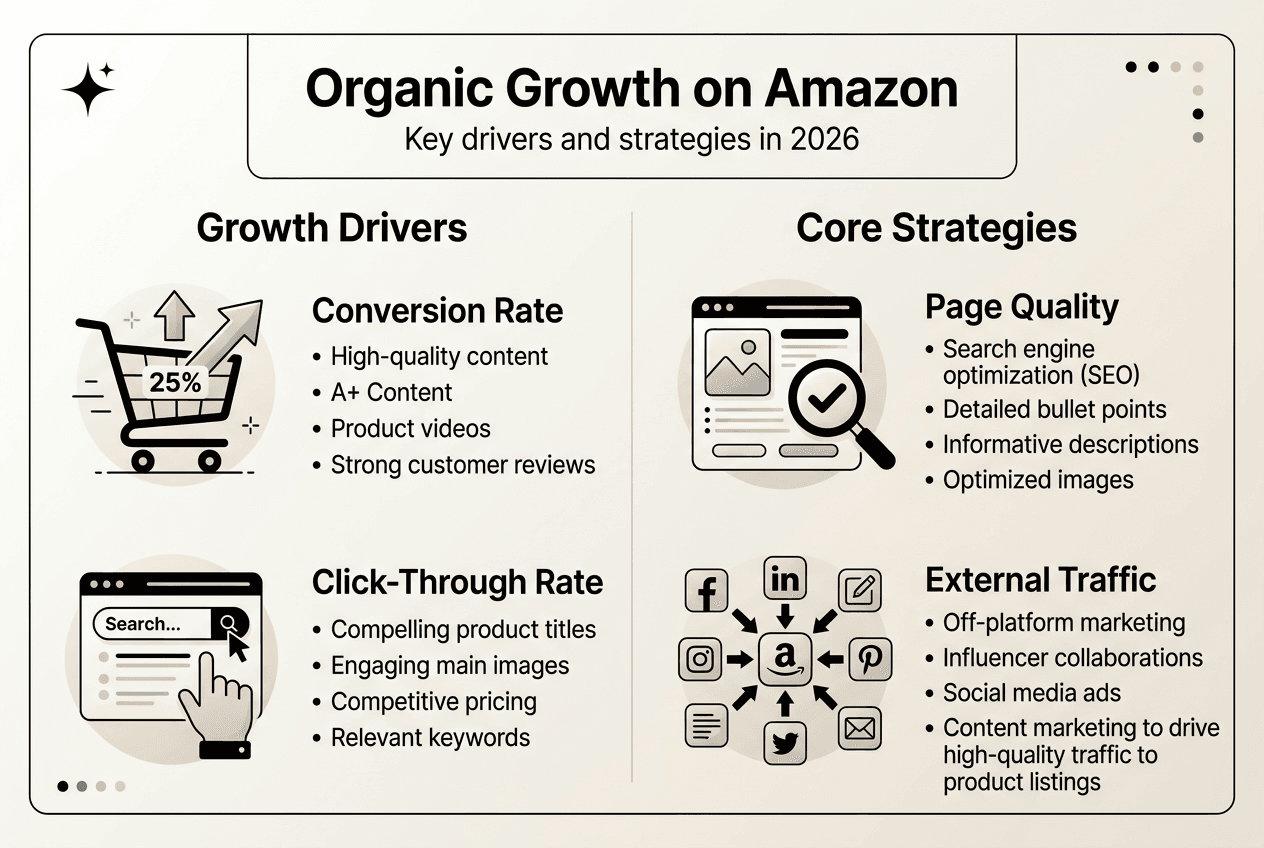
Keyword research remains important for initial discoverability, but sellers often neglect conversion drivers like compelling images and authentic reviews. Balance your keyword optimization with equal attention to the visual and social proof elements that convert browsers into buyers. Your backend search terms should capture relevant queries, but your customer-facing content must close the sale.
External traffic sources provide dual benefits for organic growth. Social media campaigns, influencer partnerships, and email marketing drive immediate sales while signaling brand strength to Amazon’s algorithm. Focus on channels where your target customers naturally gather and create content that educates rather than just promotes.
Monitor your key performance metrics weekly to identify trends and opportunities. Track conversion rate by traffic source, CTR for your top keywords, review velocity, and organic ranking positions. Use Amazon’s Brand Analytics and search term reports to understand how customers find and interact with your listings.
Follow this step-by-step process to audit and improve your listings:
- Analyze your top 10 competitors’ main images, titles, and bullet points to identify successful patterns
- Test new main images that highlight your unique value proposition and product benefits
- Rewrite bullet points to address specific customer pain points revealed in competitor reviews
- Adjust pricing to remain competitive while maintaining healthy margins
- Implement a systematic review request process for every order
- Create enhanced brand content that tells your story and builds trust
- Launch targeted external traffic campaigns to your best-performing listings
- Monitor conversion rate changes and double down on what works
Pro Tip: Excellent customer service and fast fulfillment directly improve your seller authority metrics, which boost organic rankings. Respond to messages within hours, resolve issues proactively, and use FBA when possible to maximize delivery speed.
Balancing product page quality, external marketing, and algorithm understanding creates sustainable organic growth. Your SEO efforts on Amazon should support conversion optimization rather than replace it. When you align all these elements, you reduce dependence on paid advertising while building momentum that compounds over time. The success factors that lower ACOS and protect your brand all stem from this holistic approach to organic growth.
Grow your Amazon business with expert support
Navigating Amazon’s complex ranking signals and optimization opportunities can overwhelm even experienced sellers. The strategies covered in this guide require consistent execution, data analysis, and adaptation as the platform evolves. Many successful brands partner with specialists who understand the nuances of Amazon’s ecosystem.
Agile Consultancy provides comprehensive Amazon seller services designed to maximize your organic growth while protecting your brand. Our team handles everything from data-driven PPC optimization to full account management and listing protection. We help you implement the conversion-focused strategies that drive sustainable rankings and sales.
Whether you need help optimizing your product listings, managing advertising campaigns, or scaling your Amazon presence, our specialized services deliver measurable results. Explore our expert guide to boosting Amazon sales to learn more about maximizing your success on the platform in 2026.
Frequently asked questions
What is organic growth on Amazon?
Organic growth refers to increases in product sales and search ranking that occur without paid advertising. When your listing climbs naturally in search results and generates more orders from unpaid traffic, you’re achieving organic growth. This happens when Amazon’s algorithm recognizes your product as highly relevant and valuable based on behavioral signals like conversion rate, click-through rate, and customer satisfaction metrics.
How does organic growth differ from paid advertising results?
Organic sales come from shoppers who find your product through unpaid search results, browse pages, or recommendations. Paid advertising sales result from sponsored product ads, sponsored brand campaigns, or display ads where you pay per click. Organic growth builds sustainable momentum that continues without ongoing ad spend, while paid campaigns stop generating sales when you pause them. The most successful sellers use paid ads strategically to jumpstart products, then optimize for organic growth to reduce long-term advertising costs.
Why are conversion rate and CTR so important for organic rankings?
Amazon’s A10 algorithm interprets high conversion rates as proof that your product delivers what customers want. When a larger percentage of visitors purchase, the algorithm rewards you with better visibility. Click-through rate signals that your listing appears more relevant than competitors in search results. Together, these behavioral metrics tell Amazon your product deserves prominent placement because it efficiently turns impressions into revenue.
How can I track my organic growth performance?
Monitor your organic ranking positions for target keywords using tools like Helium 10 or Jungle Scout. Track your overall conversion rate in Seller Central’s Business Reports section, filtering for organic traffic sources. Compare month-over-month organic sales growth and watch your organic share of total sales increase as your strategies take effect. Set up custom reports to separate paid and organic performance so you can measure the true impact of your optimization efforts.
Does external traffic really improve Amazon organic rankings?
Yes, driving qualified traffic from outside Amazon significantly boosts organic rankings under the A10 algorithm. When you bring customers from social media, email campaigns, or your website, Amazon interprets this as evidence of strong brand demand and product quality. External traffic that converts well carries even more ranking weight because it proves your product appeals to customers beyond Amazon’s ecosystem. Building an audience outside the platform creates a sustainable competitive advantage that compounds over time.