Role of advertising in Amazon growth: 36% ACoS drives sales
Autor: Agile Consultancy Team | Categorie: Blog | Timp de citire: 8 min

Amazon’s advertising revenue now exceeds 9% of total company revenue, marking a historic milestone that reflects the critical role ads play in seller success. For brand owners navigating the marketplace in 2026, advertising isn’t optional; it’s the engine driving visibility and sales in an increasingly crowded space. Rising costs and evolving platforms create confusion, but understanding Amazon’s advertising landscape empowers you to capture opportunities while managing profitability.
Table of Contents
- Overview Of Amazon’s Advertising Growth
- Evolution And Expansion Of Amazon Advertising Platforms
- Key Advertising Performance Metrics Explained
- Common Misconceptions About Amazon Advertising
- Challenges And Cost Trends In Amazon Advertising
Key takeaways
| Point | Details |
|---|---|
| Advertising revenue share | Advertising represents 9.36% of Amazon’s total revenue, with $56.2 billion generated globally in 2024. |
| ACoS and TACoS management | Typical ACoS ranges from 25% to 36%; tracking TACoS ensures ad spend doesn’t erode overall profit margins. |
| Platform expansion | Sponsored Products dominate budgets, but connected TV and Amazon DSP offer new reach opportunities for 2026. |
| Rising costs challenge | Average CPC is rising 10% to 15% annually, demanding strategic budget allocation and performance monitoring. |
| AI and automation advantage | Real-time bid adjustments and audience segmentation powered by AI improve efficiency and campaign ROI. |
Overview of Amazon’s advertising growth
Amazon’s advertising business has transformed from a secondary revenue stream into a financial powerhouse. Advertising accounted for 9.36% of Amazon’s total revenue by Q2 2025, a record high that underscores its strategic importance. Global ad revenue surpassed $56 billion in 2024, reflecting explosive growth as more brands invest in types of Amazon advertising to stand out.
This growth isn’t just about Amazon’s bottom line. It signals a shift in how sellers compete. With over 300 million users engaging with Amazon’s advertising ecosystem in the U.S., the platform delivers unmatched visibility. Sellers who master ad strategies tap into this massive audience, converting impressions into sales at scale.
The retail media network continues expanding, offering targeted placement options that didn’t exist five years ago. From product detail pages to off-Amazon programmatic buys, the advertising infrastructure now rivals traditional digital ad giants. For you, this means more tools but also more complexity to navigate.
Key growth indicators for sellers:
- Ad revenue growth outpaces overall Amazon revenue growth, indicating increased seller investment
- Audience reach expanded 18% year over year, providing broader targeting opportunities
- New ad formats like connected TV and Prime Video placements diversify campaign strategies
- Retail media network enhancements improve measurement and attribution for advertisers
Understanding these numbers helps you contextualize your own ad spend. When Amazon earns nearly 10% of revenue from advertising, it prioritizes tools and features that benefit advertisers. You gain access to sophisticated targeting, analytics, and placement options that drive results when used strategically.
Evolution and expansion of Amazon advertising platforms
Amazon’s advertising ecosystem has evolved far beyond simple keyword-targeted ads. Today’s platform offers multiple formats tailored to different campaign goals, from direct response to brand awareness. Sponsored Products ads command 40% to 50% of enterprise brand ad budgets, remaining the workhorse format for driving immediate conversions.
Sponsored Brands and Sponsored Display extend your reach beyond product listings. Sponsored Brands appear in prominent placements like search results and product pages, building recognition through custom headlines and brand logos. Sponsored Display enables retargeting, keeping your products visible to shoppers who viewed but didn’t purchase.
Amazon DSP opens programmatic advertising across Amazon-owned properties and third-party sites. You access display, video, and audio ad inventory, reaching audiences based on shopping behavior and demographic data. This off-Amazon capability expands your funnel, capturing attention before shoppers even search on the marketplace.
Connected TV represents the newest frontier. With ads on Prime Video and Fire TV, you engage viewers during streaming content, combining visual storytelling with direct purchase links. Early adopters report strong engagement, though costs remain higher than traditional sponsored ads.
Ad format comparison:
| Format | Primary Goal | Best For | Typical Cost |
|---|---|---|---|
| Sponsored Products | Conversions | New launches, high-margin items | Moderate CPC |
| Sponsored Brands | Awareness + conversions | Established brands, product lines | Higher CPC |
| Sponsored Display | Retargeting | Cart abandoners, repeat customers | Lower CPC |
| Amazon DSP | Reach + awareness | Large budgets, brand campaigns | CPM-based |
| Connected TV | Video engagement | Premium brands, storytelling | Premium CPM |
Pro Tip: Start with Sponsored Products to generate immediate sales data, then gradually test Sponsored Brands and Display once you understand your baseline ACoS and ROAS for core products.
The platform’s expansion means you can build sophisticated multi-channel campaigns within Amazon’s ecosystem. Match ad formats to your funnel stage: DSP and connected TV for awareness, Sponsored Products for conversion, Sponsored Display for retention. This layered approach maximizes visibility while controlling costs.
Key advertising performance metrics explained
Metrics guide every advertising decision you make on Amazon. ACoS (Advertising Cost of Sale) remains the foundational metric, calculating ad spend as a percentage of ad-attributed sales. Typical ACoS ranges from 25% to 36% depending on category competitiveness and product margins.
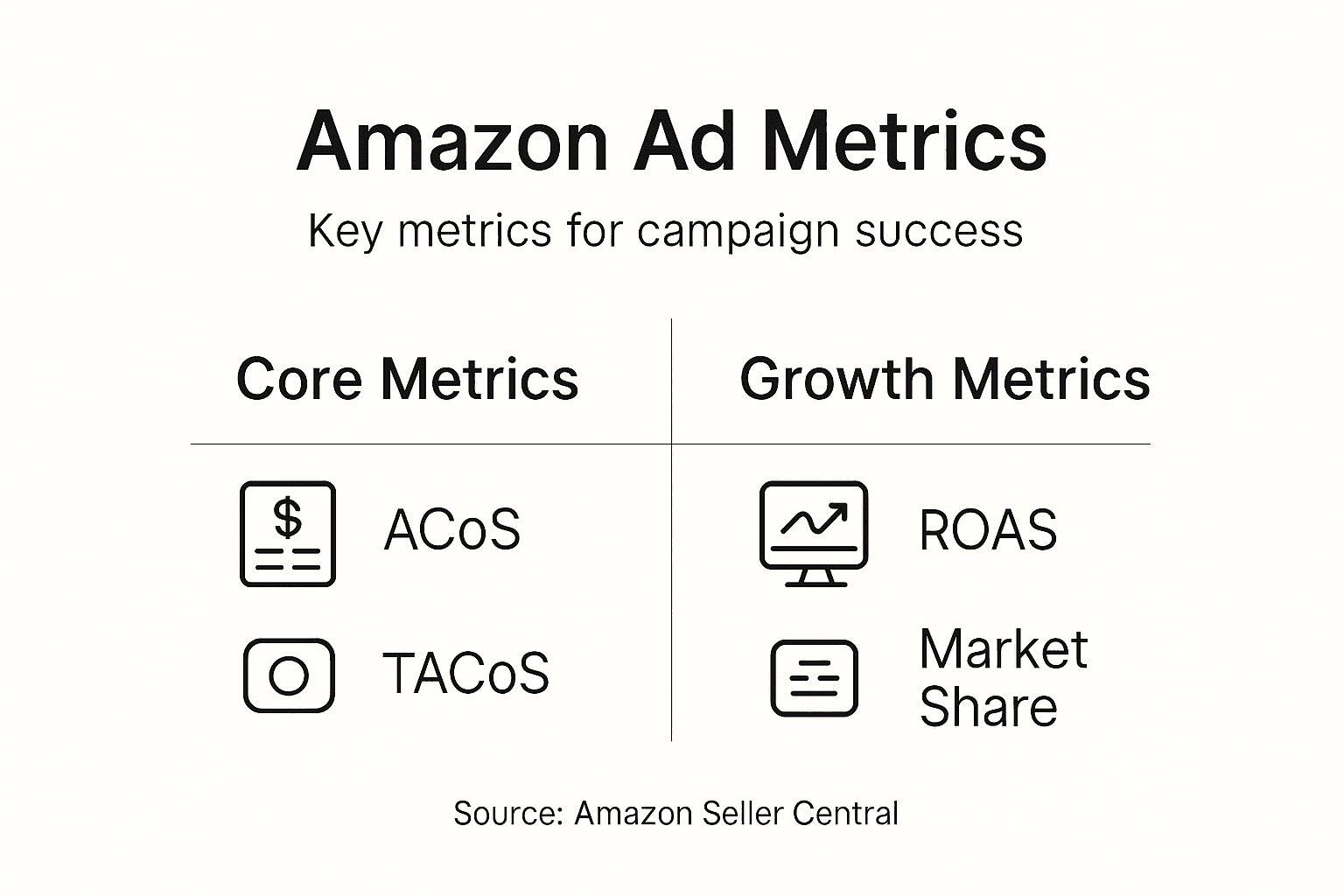
TACoS (Total Advertising Cost of Sale) provides a broader view, measuring ad spend against total sales, including organic. This metric reveals whether advertising fuels overall growth or merely cannibalizes organic sales. A healthy TACoS trends downward over time as ad-generated visibility boosts organic ranking.
ROAS (Return on Ad Spend) flips the ACoS equation, showing revenue generated per advertising dollar spent. A 3:1 ROAS means you earn three dollars for every dollar spent on ads. High-ROAS campaigns indicate efficient targeting and strong product-market fit.
Cost-per-click trends significantly impact profitability. With average CPC rising 10% to 15% annually, you must constantly optimize to maintain margins. Monitor CPC by campaign and keyword, pausing underperformers quickly.
Essential metrics to track weekly:
- ACoS by campaign and product to identify profit drains
- TACoS trends to assess advertising’s impact on total business health
- Click-through rate (CTR) to evaluate ad creative and keyword relevance
- Conversion rate to measure listing quality and product appeal
- Impression share to understand visibility relative to competitors
Pro Tip: Set target ACoS based on your product margin minus desired profit, not arbitrary industry benchmarks. A 30% margin product can sustain 15% to 20% ACoS profitably, while a 50% margin product allows 30% to 35% ACoS.
Balancing these metrics requires understanding their interdependencies. Lowering ACoS by cutting bids may reduce sales volume, hurting organic rank. Conversely, aggressive spending to gain market share must eventually moderate to protect profitability. Track all metrics together to make informed tradeoffs.
Common misconceptions about Amazon advertising
Misunderstandings about advertising metrics and strategies cost sellers money and limit growth. The belief that lowering ACoS always improves profitability ranks among the most damaging myths. Excessively low ACoS can limit growth by restricting ad spend, capping visibility and sales volume.
Consider a product with 40% margin. An ACoS of 25% generates profit and scales sales, building market share and organic ranking. Cutting ACoS to 15% may boost per-unit profit slightly but slashes ad impressions, reducing total revenue and long-term organic visibility. The optimal ACoS balances immediate profit with growth investment.
Another myth suggests advertising directly improves organic search rankings. While ads boost visibility and can indirectly support ranking through increased sales velocity and reviews, Amazon’s A9 algorithm prioritizes listing quality, relevance, and conversion rate. Poor listings won’t rank organically no matter how much you spend on ads.
Sellers also assume aggressive ad spending remains affordable as revenue grows. Rising competition drives CPC increases of 10% to 15% yearly, and some categories see ad costs consume over 50% of revenue. Sustainable growth requires strategic budget allocation, not unlimited spending.
Debunked advertising myths:
- Myth: Lower ACoS equals higher profit. Reality: Too-low ACoS restricts sales volume and market share gains.
- Myth: Ads guarantee better organic ranking. Reality: Ads help visibility; listing optimization drives organic ranking.
- Myth: More ad spend always increases profit. Reality: Diminishing returns and rising CPC demand efficiency, not just volume.
- Myth: Pausing ads saves money without consequences. Reality: Ad pauses can tank organic rank by reducing sales velocity.
Approach advertising with a balanced perspective. Aim for sustainable ACoS that funds growth while maintaining profitability. Invest in listing optimization alongside ad spend to maximize both paid and organic performance. Monitor cost trends and adjust strategies as marketplace dynamics shift.
Challenges and cost trends in Amazon advertising
Rising advertising costs present the biggest challenge for Amazon sellers in 2026. Average CPC has increased 10% to 15% year-over-year, squeezing margins across categories. High-competition keywords in electronics, home goods, and supplements see CPC exceeding $3, making profitable campaigns difficult without strong unit economics.
Some sellers report advertising consuming over 50% of revenue, a ratio that leaves little room for other business expenses or profit. This cost pressure forces difficult decisions: reduce ad spend and risk losing visibility, or maintain spend and accept razor-thin margins. Neither option feels sustainable long-term.
Marketplace saturation amplifies cost challenges. As more sellers compete for the same keywords and placements, auction dynamics push CPC higher. Categories that were affordable two years ago now require sophisticated strategies to achieve positive ROI. You can’t simply
Recommended
- Amazon Seller Success Factors: 30% Lower ACOS & Brand Protection | Agile Consultancy Blog
- 6 Key Types of Amazon Advertising for Brand Growth | Agile Consultancy Blog
- Role of SEO on Amazon: Driving Organic Growth | Agile Consultancy Blog
- Master the Amazon Brand Management Process for Growth | Blog Agile Consultancy