How seller feedback drives your Amazon success in 2026
Autor: Agile Consultancy Team | Categorie: Blog | Timp de citire: 13 min

Your Amazon seller rating sits quietly in the background, but it controls whether you win the Buy Box, rank in search results, or face account suspension. While most sellers obsess over product reviews, seller feedback determines Buy Box eligibility and search visibility in ways that directly impact your bottom line. This guide reveals how seller feedback influences critical performance metrics, the common mistakes that trigger negative ratings, and practical strategies to protect and improve your seller account health. Understanding these dynamics separates thriving sellers from those struggling to maintain their Amazon presence.
Table of Contents
- Why Seller Feedback Matters On Amazon
- Understanding Key Seller Performance Metrics Linked To Feedback
- Common Causes Of Negative Seller Feedback And Management Strategies
- Leveraging FBA And Operational Excellence To Boost Seller Feedback
- How Agile Consultancy Can Elevate Your Seller Feedback Management
- Frequently Asked Questions About The Role Of Seller Feedback
Key takeaways
| Point | Details |
|---|---|
| Seller feedback controls visibility | Your feedback score directly influences Buy Box eligibility and search ranking position on Amazon |
| ODR threshold is critical | Order Defect Rate must stay below 1% or risk account suspension and loss of selling privileges |
| Shipping speed matters most | Late shipments trigger the majority of negative feedback even with one day delays |
| FBA reduces logistics risks | Fulfillment by Amazon handles shipping metrics but sellers remain responsible for product quality |
| Automation prevents problems | Manual feedback management fails at scale requiring automated monitoring and response systems |
Why seller feedback matters on Amazon
Amazon’s algorithm treats seller feedback as a trust signal that determines which sellers deserve premium placement. Seller feedback impacts search rankings and Buy Box eligibility more than many sellers realize, creating a direct connection between your rating and revenue potential. When customers evaluate sellers, they look beyond product features to assess reliability, communication quality, and fulfillment speed.
The platform maintains strict performance standards because customer experience drives marketplace success. Feedback scores below 4.0 stars trigger automatic account reviews and potential restrictions. Amazon doesn’t tolerate poor seller performance because it damages customer trust across the entire ecosystem. Your seller rating communicates operational competence to both the algorithm and potential buyers.
Understanding the distinction between product reviews and seller feedback proves essential for account management. Product reviews evaluate the item itself while seller feedback assesses your service quality, shipping speed, and communication. This separation means you can sell excellent products but still receive negative seller feedback due to late shipments or poor customer service.
Several key metrics tie directly to seller feedback:
- Order Defect Rate measuring negative feedback, claims, and chargebacks
- Late Shipment Rate tracking delivery timing against promised dates
- Pre-Fulfillment Cancellation Rate showing order management effectiveness
- Customer response time indicating communication quality
These metrics combine to create your overall seller performance score. Amazon monitors them continuously, adjusting your account status based on performance trends. Sellers who ignore these connections often discover problems only after facing restrictions or suspension.
Pro Tip: Check your seller feedback score weekly rather than monthly to catch negative trends before they escalate into account health issues that require weeks to resolve.
The competitive advantage of strong seller feedback extends beyond algorithm preferences. Customers actively compare seller ratings when choosing between similar products at comparable prices. A 98% positive rating attracts significantly more conversions than a 92% rating, even when product quality remains identical. This trust factor becomes especially critical for Amazon growth strategies in 2026 where marketplace competition intensifies.
Understanding key seller performance metrics linked to feedback
Amazon calculates Order Defect Rate by comparing defective orders to total orders over a rolling 60-day period. This metric combines three distinct problem types: negative feedback ratings, A-to-z Guarantee claims, and credit card chargebacks. Each component signals customer dissatisfaction and operational failures that Amazon penalizes.
The platform requires sellers to maintain ODR below 1% at all times. Crossing this threshold triggers immediate account reviews and possible suspension. Sellers approaching 0.8% receive warning notifications, but waiting for warnings creates unnecessary risk. Proactive monitoring prevents problems before they threaten your selling privileges.
Late Shipment Rate measures the percentage of orders shipped after the expected ship date you committed to customers. This metric directly reflects fulfillment reliability and operational efficiency. Even minor delays accumulate into performance issues that damage seller ratings and customer trust.
Pre-Fulfillment Cancellation Rate tracks orders you cancel before shipping, indicating inventory management problems or listing inaccuracies. High cancellation rates suggest you’re selling products you can’t deliver, creating customer frustration and account health risks.
| Metric | Definition | Threshold | Impact |
|---|---|---|---|
| Order Defect Rate | Percentage of orders with negative feedback, claims, or chargebacks | Below 1% | Account suspension risk above threshold |
| Late Shipment Rate | Orders shipped after promised date | Below 4% | Reduced Buy Box eligibility and search rank |
| Pre-Fulfillment Cancellation | Orders canceled before shipping | Below 2.5% | Customer trust damage and potential restrictions |
| Customer Response Time | Time to respond to buyer messages | Within 24 hours | Lower ratings and reduced customer satisfaction |
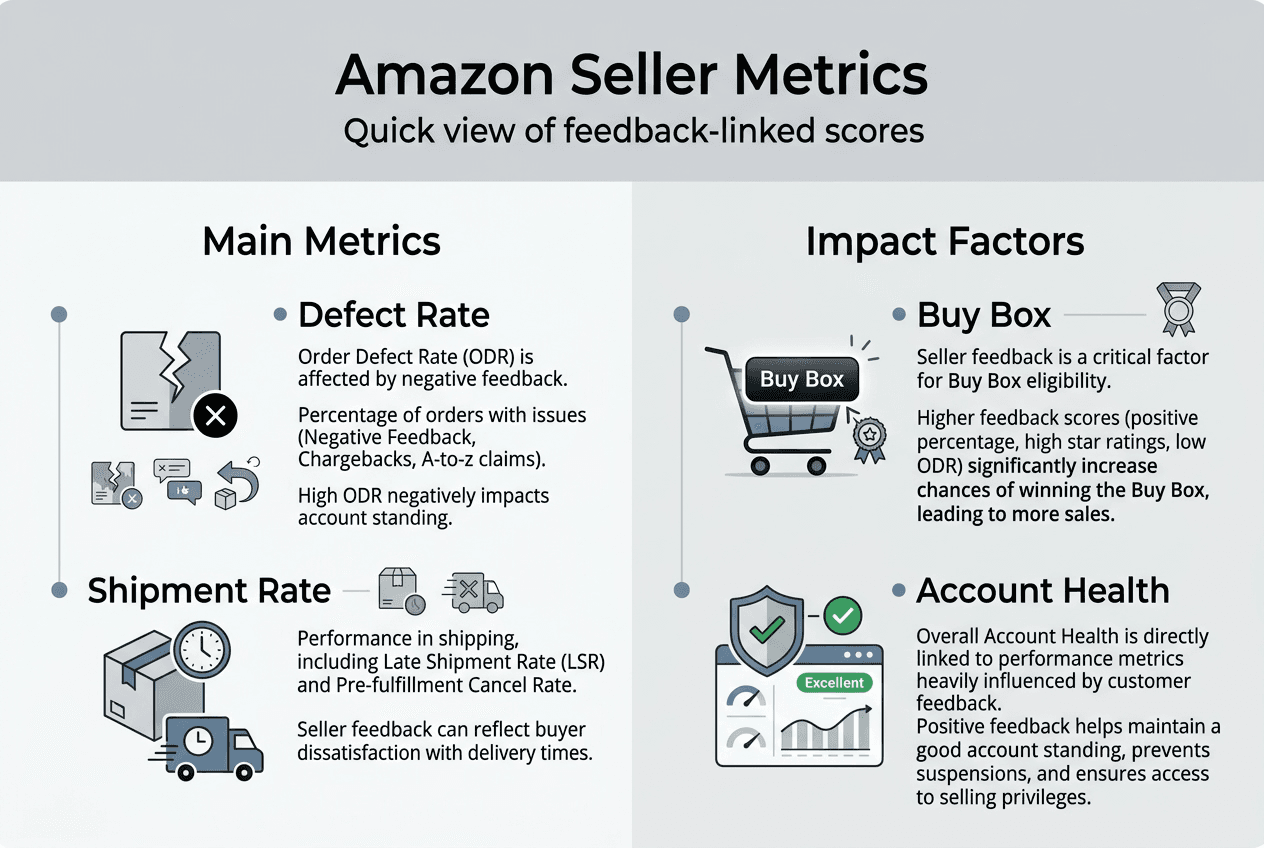
These critical performance thresholds create clear operational targets. Staying comfortably below each limit provides buffer room for occasional issues without triggering penalties. Sellers operating near thresholds live dangerously, where a single bad week can cause serious account problems.
Pro Tip: Set internal performance targets 20% better than Amazon’s requirements so temporary spikes in defects or late shipments never approach suspension thresholds.
The interconnected nature of these metrics means problems in one area often cascade into others. Late shipments trigger negative feedback, increasing ODR. Poor communication leads to A-to-z claims, also raising ODR. Inventory mismanagement causes cancellations while damaging customer relationships. Successful sellers recognize these connections and build systems preventing problems across all metrics simultaneously.
Monitoring tools within Seller Central provide real-time visibility into performance trends. The Account Health dashboard displays current metrics, recent customer feedback, and policy compliance status. Regular review of this dashboard helps identify emerging issues before they escalate. Sellers who check metrics daily respond faster to problems than those reviewing weekly or monthly. This Amazon seller success approach prioritizes prevention over reaction.
Common causes of negative seller feedback and management strategies
Late shipments drive the majority of negative seller feedback, with even single-day delays triggering customer complaints. Buyers expect the delivery dates you promise, and missing those commitments damages trust regardless of your reasons. Shipping delays communicate unreliability and poor operational management to customers who have numerous alternative sellers.

Poor communication ranks as the second most common complaint in seller feedback. Customers who can’t reach you or receive slow responses assume you don’t care about their concerns. Unanswered questions about shipping status, product details, or return policies create frustration that manifests as negative ratings.
Amazon recently introduced star-only ratings without written comments, complicating feedback analysis. Sellers can no longer read customer explanations for low ratings, making it harder to identify specific improvement areas. This change requires more proactive performance monitoring and customer service excellence since you can’t rely on feedback comments to diagnose problems.
Product quality issues appear in seller feedback even though they technically belong in product reviews. Customers often conflate the two systems, leaving seller feedback that complains about product defects or inaccurate descriptions. While these ratings violate Amazon’s feedback policies, removal requires manual requests and doesn’t always succeed.
Key drivers of negative feedback include:
- Shipping delays beyond promised delivery dates
- Poor packaging leading to damaged products
- Inaccurate product descriptions creating unmet expectations
- Slow or unhelpful customer service responses
- Missing items or wrong products shipped
Managing negative feedback requires understanding Amazon’s removal policies. You can request removal of feedback that contains obscene language, includes seller-specific personal information, or relates entirely to product quality rather than seller performance. Submit removal requests through Seller Central, providing clear justification for each case.
Pro Tip: Respond professionally to all negative feedback within 24 hours even if removal requests are pending, showing future customers you take concerns seriously and maintain high service standards.
Automation becomes essential as order volume grows beyond manual management capacity. Tracking every order, monitoring feedback, and responding to customer messages manually works for small operations but fails at scale. Automated systems monitor performance metrics continuously, alert you to problems immediately, and streamline customer communication.
Feedback request automation helps generate positive ratings by prompting satisfied customers to share their experience. Timing these requests appropriately increases response rates without annoying buyers. Most effective systems send requests 3-5 days after delivery when customers have used the product but still remember the transaction.
Prevention strategies prove more effective than damage control. Building operational excellence into your fulfillment process eliminates most feedback problems before they occur. This means accurate inventory management, reliable shipping partners, quality control checks, and responsive customer service. Sellers who excel operationally rarely face serious feedback issues because they consistently meet customer expectations. Understanding common Amazon seller mistakes helps avoid feedback problems. Implementing Amazon seller management software provides the automation necessary for consistent performance.
Leveraging FBA and operational excellence to boost seller feedback
FBA improves seller ratings by transferring shipping responsibility to Amazon’s logistics network. This arrangement eliminates late shipment concerns from your performance metrics since Amazon handles fulfillment timing. Customers receive Prime-eligible fast shipping, increasing satisfaction and reducing delivery-related complaints.
The Late Shipment Rate metric doesn’t apply to FBA sellers because Amazon controls the fulfillment process. This protection proves valuable for sellers who struggle with logistics management or lack reliable shipping infrastructure. FBA sellers avoid LSR accountability while maintaining responsibility for product quality and accurate listings.
However, FBA doesn’t eliminate all seller feedback risks. You remain fully responsible for product quality, description accuracy, and customer service. Defective products, misleading listings, or poor communication still generate negative feedback and increase ODR. FBA solves logistics problems but doesn’t excuse operational failures in other areas.
| Factor | FBA Impact | Merchant Fulfilled Impact |
|---|---|---|
| Late Shipment Rate | Not applicable, Amazon handles shipping | Directly affects seller metrics |
| Product Quality Control | Seller responsibility remains | Seller responsibility remains |
| Customer Service | Shared between Amazon and seller | Entirely seller responsibility |
| Packaging Standards | Amazon standards apply | Seller standards apply |
| Return Processing | Amazon manages returns | Seller manages returns |
Operational best practices for maintaining excellent seller feedback:
- Create detailed, accurate product listings that set realistic customer expectations about features, size, and quality.
- Implement quality control checks before sending inventory to FBA or shipping directly to ensure products meet descriptions.
- Respond to customer messages within 12 hours maximum, ideally within 2-4 hours during business hours.
- Monitor inventory levels continuously to prevent stockouts that lead to cancellations and disappointed customers.
- Use professional packaging that protects products during shipping and creates positive unboxing experiences.
- Track performance metrics daily through Seller Central dashboards to identify problems immediately.
Operational excellence creates a foundation for positive seller feedback regardless of fulfillment method. Sellers who maintain high standards across product quality, communication, and accuracy rarely face serious feedback issues. This consistency builds customer trust and generates organic positive ratings without aggressive solicitation.
The correlation between operational discipline and seller feedback appears clearly in performance data. Sellers with detailed processes, quality checks, and responsive service maintain ratings above 95% positive consistently. Those relying on reactive problem-solving struggle to break 90% because they’re constantly addressing issues rather than preventing them.
Combining FBA with operational excellence creates the strongest foundation for Amazon seller success. This approach eliminates logistics concerns while maintaining control over product quality and customer relationships. The result is consistently high seller feedback that drives Buy Box wins, search visibility, and sustainable revenue growth.
How Agile Consultancy can elevate your seller feedback management
Managing seller feedback effectively requires expertise, time, and sophisticated tools that many sellers lack internally. Agile Consultancy specializes in comprehensive Amazon seller services that optimize account health, improve performance metrics, and protect your brand reputation. Our team handles the complex details of feedback monitoring, response automation, and performance optimization so you can focus on product development and business growth.
Our expert account management services include proactive feedback monitoring, strategic response protocols, and automated systems that maintain excellent seller ratings. We implement data-driven PPC strategies that increase visibility while managing advertising costs, creating sustainable growth without sacrificing profitability. Brand protection services safeguard your listings from hijackers and unauthorized sellers who damage your reputation. Understanding why professional account management matters helps sellers recognize when outsourcing delivers better results than internal management. Our comprehensive Amazon brand management process ensures every aspect of your seller presence supports long-term success.
Frequently asked questions about the role of seller feedback
What is the difference between seller feedback and product reviews?
Seller feedback evaluates your service quality, shipping speed, and communication while product reviews assess the item itself. Customers leave seller feedback based on their transaction experience, not product features. This distinction matters because you can’t remove negative product reviews, but you can request removal of seller feedback that violates Amazon’s policies or relates entirely to product quality rather than your service.
How does negative seller feedback affect my Amazon account health?
Negative feedback directly increases your Order Defect Rate, which must stay below 1% to avoid suspension. Each negative rating counts as a defect in Amazon’s calculation, combining with A-to-z claims and chargebacks. High defect rates trigger account reviews, loss of Buy Box eligibility, reduced search visibility, and potential selling privilege suspension. Even ratings that don’t push you over thresholds damage customer trust and reduce conversion rates.
Can I remove negative seller feedback from Amazon?
Amazon allows removal of feedback containing obscene language, seller-specific personal information, or comments entirely about product quality rather than your service. Submit removal requests through Seller Central with clear justification for each case. Amazon reviews requests manually and approves valid removals within 24-48 hours. Feedback about late shipping, poor communication, or service quality typically cannot be removed even if you disagree with the customer’s assessment.
How can I improve my seller feedback ratings effectively?
Focus on operational excellence by shipping on time, communicating promptly, and ensuring product quality matches descriptions. Implement automated feedback request systems that prompt satisfied customers to leave positive ratings 3-5 days after delivery. Monitor performance metrics daily to catch problems immediately before they escalate. Respond professionally to all negative feedback within 24 hours, demonstrating commitment to customer satisfaction. Consider FBA to eliminate shipping-related feedback issues. Following this Amazon seller step-by-step guide helps build sustainable feedback improvement systems.
Does using FBA guarantee better seller feedback?
FBA eliminates Late Shipment Rate concerns since Amazon handles fulfillment, typically improving overall ratings. However, FBA doesn’t guarantee positive feedback because you remain responsible for product quality, listing accuracy, and customer service. Defective products or misleading descriptions still generate negative ratings regardless of fulfillment method. FBA provides a strong foundation for good feedback by ensuring reliable shipping, but operational excellence across all areas determines your ultimate rating success.