Boost your Amazon sales in 2026: expert step-by-step guide
Autor: Agile Consultancy Team | Categorie: Blog | Timp de citire: 11 min

Scaling your Amazon business in 2026 demands more than basic keyword tactics and occasional promotions. Many sellers struggle to achieve consistent sales growth while protecting their brand from hijackers and algorithm penalties. Amazon’s marketplace has evolved into a complex ecosystem requiring strategic PPC optimization, precise category placement, and continuous performance monitoring. This guide walks you through a proven, step-by-step process combining algorithm insights with expert account management strategies to boost sales and safeguard your listings effectively.
Table of Contents
- Understanding The Amazon Sales Boost Problem
- Preparation: Key Prerequisites For Boosting Amazon Sales
- Execution: Optimizing PPC Campaigns For Scalable Sales Growth
- Verification And Ongoing Brand Protection Strategies
- Boost Your Amazon Success With Expert Support
Key takeaways
| Point | Details |
|---|---|
| Algorithm complexity | Amazon processes hundreds of ranking signals simultaneously, requiring multi-factor optimization beyond simple keywords |
| Product positioning | Category selection and listing optimization directly impact visibility and conversion rates |
| PPC precision | Continuous campaign refinement with negative keywords reduces wasted spend by up to 60% |
| Performance tracking | Regular monitoring of KPIs and listing health prevents revenue loss from suppressions or hijacks |
| Brand protection | Proactive safeguards through registry and automated alerts maintain sales momentum and market position |
Understanding the Amazon sales boost problem
Boosting sales on Amazon in 2026 presents unique challenges that go far beyond traditional e-commerce tactics. Amazon’s ranking algorithm has become a complex decision engine that factors in much more than just a product’s keywords and sales spike. The platform now processes hundreds of signals simultaneously to determine which products deserve top placement in search results.
The algorithm evaluates multiple dimensions:
- Relevance signals matching product attributes to search queries
- Buyer intent alignment through behavioral data and purchase patterns
- Performance metrics including click-through rates and conversion velocity
- Trust indicators such as review quality, seller rating, and fulfillment method
- Historical behavior patterns showing consistency and reliability
The product ranking algorithm is now driven by three high-level intents: optimizing marketplace revenue, maximizing customer satisfaction, and aligning buyer intent with product offerings. This multi-layered approach means sellers must address algorithm requirements holistically rather than focusing on isolated tactics.
Conversion rates carry significant weight in rankings, representing roughly 30 to 40 percent of the overall ranking calculation. A product that attracts clicks but fails to convert signals poor quality or misalignment to Amazon’s system, resulting in suppressed visibility. Understanding this complexity is essential for anyone serious about sustainable growth on the Amazon marketplace.
Success on Amazon requires understanding that the algorithm balances revenue generation with customer satisfaction. Products that convert well while maintaining positive feedback create a virtuous cycle of improved visibility and sustained sales growth.
The challenge intensifies as Amazon continuously refines its ranking factors without publishing exact weightings or formulas. Sellers must adapt strategies based on performance data and marketplace trends rather than relying on outdated playbooks from previous years.
Preparation: key prerequisites for boosting Amazon sales
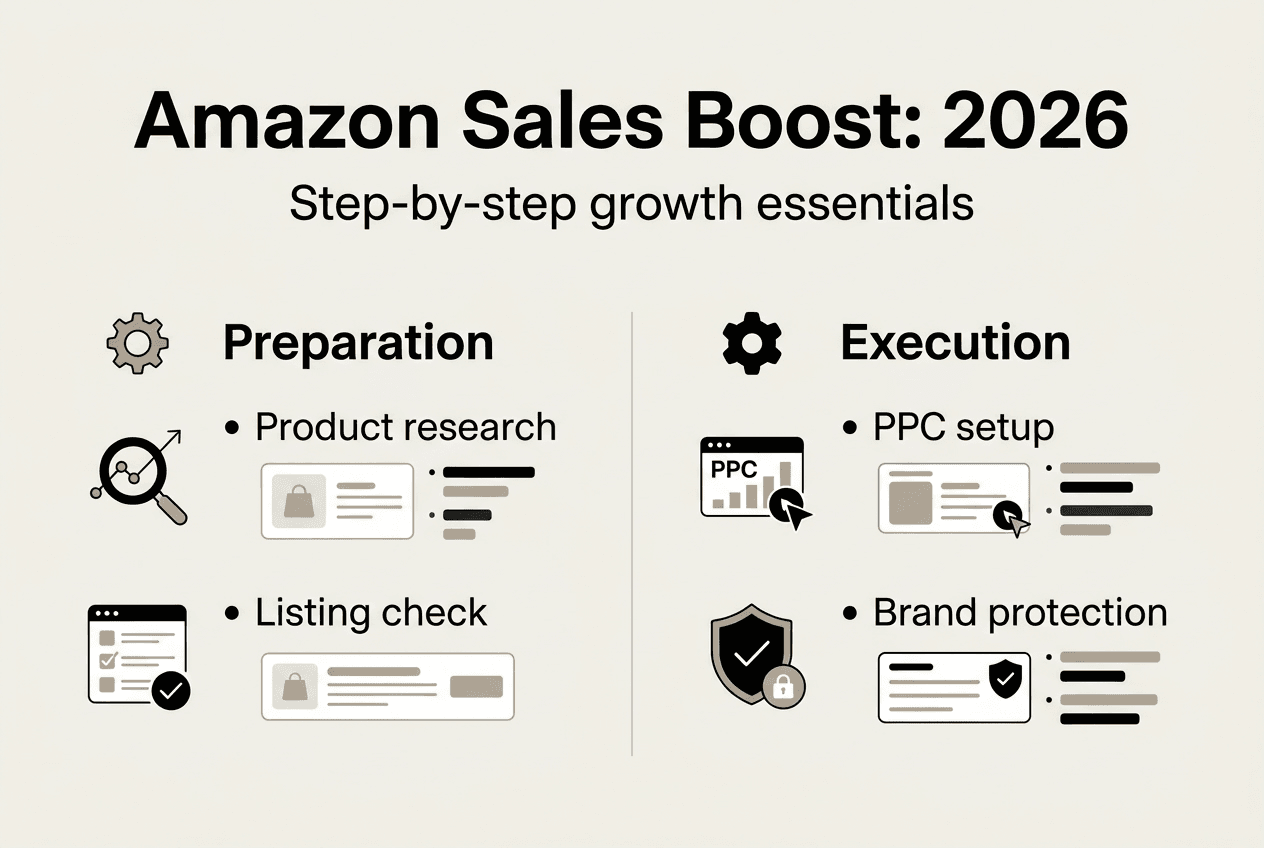
Before launching sales-boost campaigns, you must establish a solid foundation through strategic product selection and listing optimization. Choosing the right products and categories is crucial, as errors can affect visibility, conversion rates, and profitability from day one.
Start by analyzing demand and competition within your target categories. Products launched into oversaturated markets face uphill battles regardless of quality or pricing. Conversely, selecting niche categories with steady demand and moderate competition positions your listings for faster traction and better organic visibility.
Category placement deserves careful attention because incorrect categorization suppresses product discovery even with perfect listings. Amazon’s algorithm uses category data to match products with relevant searches, so misplacement directly impacts how often potential buyers see your offerings. Review category options thoroughly and select the most specific, relevant classification available.
Optimizing product listings forms the second critical preparation step:
- Craft clear, keyword-rich titles that communicate product benefits within the first 80 characters
- Use high-quality images showing products from multiple angles with lifestyle context
- Write bullet points highlighting key features and addressing common customer questions
- Develop detailed descriptions that build trust and answer objections
- Include backend search terms to capture additional relevant queries
Alignment with buyer intent separates successful listings from those that struggle. Your product presentation must match what customers expect when searching specific terms. If someone searches for “waterproof hiking boots,” your listing should immediately confirm waterproof capabilities rather than burying that detail in fine print.
Pro Tip: Conduct quarterly audits of your product categories and listings to ensure alignment with evolving trends and algorithm updates. Categories that performed well six months ago may have shifted in competition or relevance, requiring strategic adjustments to maintain visibility.
Avoid common Amazon seller mistakes by validating demand before inventory investment and testing listing variations to identify highest-converting formats. This preparation phase determines whether your subsequent PPC and promotion efforts amplify success or waste budget on fundamentally flawed positioning.
Execution: optimizing PPC campaigns for scalable sales growth
PPC campaign optimization represents the most direct lever for boosting Amazon sales when executed with precision and continuous refinement. Poor campaign management drains budgets while delivering minimal returns, but strategic approaches reduce wasted spend and accelerate profitable growth.

Begin with targeted manual campaigns focused on converting keywords rather than broad automatic campaigns that capture irrelevant traffic. Manual campaigns provide granular control over which search terms trigger your ads, allowing budget allocation toward high-intent queries that generate sales.
Follow this execution framework:
- Launch manual exact-match campaigns for your top 10 to 15 converting keywords
- Run search term reports weekly to identify new keyword opportunities and wasteful spending
- Add negative keywords aggressively to eliminate non-converting traffic
- Adjust bids based on placement performance, increasing for top-of-search and reducing for low-converting placements
- Segment campaigns by product line or price tier for precise budget control and performance tracking
PPC campaigns can underperform due to broad campaigns without negative keywords and poor placement analysis. A case study showed that adding negative keywords and optimizing campaign placements reduced wasted spend by 60 percent while maintaining sales volume.
Placement optimization deserves special attention because top-of-search placements convert differently than product detail page placements. Analyze performance by placement type and adjust bid modifiers accordingly. Top-of-search typically commands premium bids due to higher visibility, but only if conversion rates justify the increased cost.
| Campaign Type | Best Use Case | Pros | Cons | | — | — | — | | Manual Exact | High-intent keywords with proven conversion | Maximum control, lowest wasted spend | Requires ongoing keyword research | | Manual Phrase | Moderate-intent broader terms | Captures variations, manageable cost | Needs frequent negative keyword additions | | Automatic | Discovery and testing | Identifies new opportunities | High initial waste without monitoring | | Product Targeting | Competitor conquest | Captures ready-to-buy traffic | Expensive, requires strong differentiation |
Automation tools enhance campaign management by monitoring performance and adjusting bids based on predefined rules. These tools respond faster than manual management, capturing opportunities during high-traffic periods while protecting budgets during low-conversion windows. However, automation requires proper setup and ongoing oversight to prevent algorithmic drift from business objectives.
Pro Tip: Create separate campaigns for different price tiers within your catalog. High-margin products justify aggressive bidding for premium placements, while lower-margin items require conservative strategies focused on efficiency over volume.
Regular PPC optimization audits identify performance gaps and opportunities that daily management overlooks. Quarterly deep dives into campaign structure, keyword relevance, and competitive positioning ensure your advertising strategy evolves with marketplace dynamics. Understanding types of Amazon advertising options expands your toolkit for reaching customers across different stages of the buying journey.
Verification and ongoing brand protection strategies
Sustaining sales growth requires systematic verification of campaign performance and proactive brand protection against marketplace threats. Without ongoing monitoring, initial gains erode through algorithm changes, competitor actions, or listing vulnerabilities.
Establish measurable KPIs that reflect business health:
- Sales volume trends across daily, weekly, and monthly timeframes
- Conversion rate changes indicating listing effectiveness
- ACOS (Advertising Cost of Sale) tracking profitability of ad spend
- Customer feedback scores revealing satisfaction and potential issues
- Organic ranking positions for target keywords
Regular audits of listings and PPC campaigns surface performance gaps before they significantly impact revenue. Weekly reviews catch emerging problems like suppressed listings, hijacked buy boxes, or sudden ranking drops that require immediate intervention. Amazon does not publish its exact ranking factors, making ongoing monitoring and adjustment essential for maintaining competitive positions.
Brand protection forms an integral component of sustainable sales growth. Hijackers and counterfeiters damage brand reputation while diverting sales, and Amazon’s marketplace structure creates vulnerabilities that require active defense:
- Enroll in Amazon Brand Registry to access enhanced protection tools and reporting mechanisms
- Implement automated monitoring alerts for unauthorized sellers on your listings
- Establish clear MAP (Minimum Advertised Price) policies and enforce them consistently
- Document intellectual property thoroughly to support infringement claims
- Respond within 24 hours to listing suppressions or hijack attempts
Comparing brand protection approaches helps prioritize resources:
| Protection Method | Features | Implementation Cost | Effectiveness |
|---|---|---|---|
| Brand Registry | Trademark protection, enhanced content, reporting tools | Free (requires trademark) | High for registered brands |
| Automated Monitoring | Real-time alerts, hijacker detection, price tracking | $50 to $500 monthly | Very high for proactive defense |
| Third-Party Services | Full-service monitoring, takedown support, legal assistance | $500+ monthly | Highest for complex cases |
| Manual Monitoring | DIY checking, direct reporting | Time investment only | Moderate, reactive only |
Quick response to listing issues prevents extended revenue loss. A suppressed listing loses sales immediately, and delayed resolution compounds the problem as organic rankings decay during downtime. Maintain documentation of product compliance, safety certifications, and intellectual property to expedite Amazon support resolution.
The Amazon seller success factors demonstrate how integrated strategies combining PPC optimization with brand protection deliver superior results compared to isolated tactics. Sellers who view brand protection as optional risk undermining their growth investments when preventable issues disrupt sales momentum.
Boost your Amazon success with expert support
Navigating Amazon’s complex marketplace while scaling sales and protecting your brand demands specialized expertise and continuous optimization. Many successful sellers accelerate growth by partnering with professionals who manage the technical details while they focus on product development and business strategy.
Agile Consultancy provides comprehensive Amazon seller services tailored to brands seeking sustainable marketplace growth. Our team combines data-driven PPC optimization with proactive account management and brand protection strategies that prevent costly mistakes and capitalize on emerging opportunities. Real results from our Amazon PPC audit case study show how strategic campaign refinement reduces wasted spend while increasing sales velocity. Whether you need full account management or targeted optimization support, expert guidance transforms Amazon challenges into competitive advantages that drive long-term success.
FAQ
What is the most important factor in Amazon’s ranking algorithm?
Conversion rate holds the highest weight in Amazon’s ranking calculations, representing roughly 30 to 40 percent of overall ranking influence. Products that convert browsers into buyers signal quality and relevance to Amazon’s algorithm, earning improved visibility in search results. Focus optimization efforts on elements that drive conversions, including compelling images, clear value propositions, competitive pricing, and strong reviews.
How can I effectively reduce wasted PPC spend?
Regularly review search term reports to identify and exclude irrelevant keywords through negative keyword lists. Adding negative keywords and optimizing placements reduced wasted spend by 60 percent in documented cases. Adjust bids based on placement performance data, increasing investment in high-converting placements while reducing or eliminating spend on underperforming positions. Implement PPC optimization audits quarterly to identify structural improvements beyond daily management adjustments.
What are common mistakes sellers make with product categories?
Sellers frequently choose categories without researching demand levels or competitive intensity, leading to poor visibility and low conversion rates. Errors like entering highly competitive categories or wrong placement hurt visibility and profitability from launch. Correct category placement ensures better algorithm alignment and customer discovery by matching your product with relevant searches. Review Amazon seller mistakes to avoid for comprehensive guidance on category selection and other critical positioning decisions.
How often should I audit my Amazon listings and campaigns?
Conduct lightweight weekly reviews of key performance metrics including sales trends, ACOS changes, and listing health indicators. Perform comprehensive monthly audits examining campaign structure, keyword performance, and competitive positioning. Schedule quarterly strategic reviews that assess category relevance, pricing strategy, and brand protection effectiveness. This layered approach catches urgent issues quickly while ensuring long-term strategy remains aligned with marketplace evolution and business objectives.