Amazon Audit Role: 18% Revenue Growth & 25% PPC Cost Cut
Autor: Agile Consultancy Team | Categorie: Blog | Timp de citire: 14 min

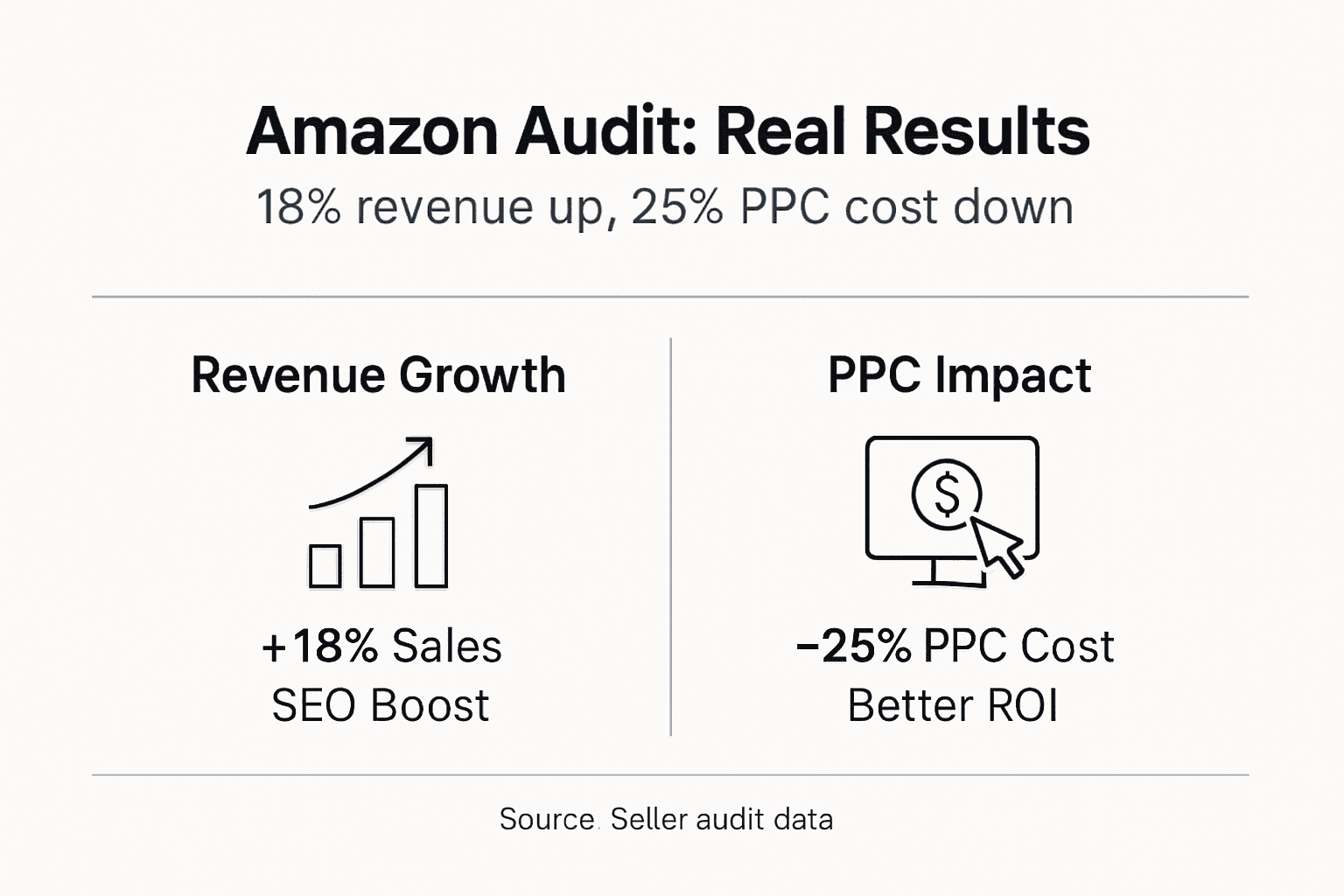
Strategic audits reveal what most Amazon sellers overlook: critical gaps in compliance, PPC performance, and listing health that silently erode profitability. When implemented quarterly, these Amazon brand management process audits deliver measurable results, averaging 18% revenue growth year over year while slashing advertising waste. This article explores how audits transform from routine checks into powerful growth engines for your marketplace business.
Table of Contents
- How Audits Support Compliance and Reduce Risks
- Identifying Hidden Account Issues Through Audits
- Audit-Driven Ppc and Advertising Optimization
- Audit Impact on Amazon Listing Hijacking Prevention
- Common Misconceptions About Audits
- Framework for Implementing Audits as Growth Levers
- Case Examples of Audit-Driven Improvements
- Audit Frequency and Timing Best Practices for Sustainable Growth
- Get Expert Support to Leverage Audits for Amazon Growth
- Frequently Asked Questions
Key Takeaways
| Point | Details |
|---|---|
| Revenue Impact | Quarterly audits boost seller revenue by an average of 18% year over year through strategic optimization. |
| ACOS Reduction | PPC audits reduce Advertising Cost of Sale by up to 25% by identifying inefficient keywords and bid strategies. |
| Compliance Detection | Audits uncover compliance and listing issues affecting 30% of accounts, preventing suspensions and sales loss. |
| Strategic Value | Audits extend beyond financial reviews to drive operational improvements and protect brand integrity. |
| Optimal Frequency | Quarterly audits balance actionable insights with resource efficiency for sustained marketplace success. |
How Audits Support Compliance and Reduce Risks
Amazon’s internal audit and compliance reviews focus on mitigating risks related to listing accuracy, account health, and policy compliance. For sellers, these same principles apply. Your account health directly impacts visibility, Buy Box eligibility, and long-term growth potential.
Seller audits systematically examine policy adherence, product authenticity documentation, content compliance, and pricing practices. When you manage seller accounts to protect your brand, you catch violations before Amazon does. Account suspensions devastate revenue streams, often taking weeks to resolve while competitors capture your market share.
Compliance audits identify risks across multiple dimensions. Product authenticity verification ensures you can prove legitimate sourcing. Content reviews catch restricted claims or prohibited language that trigger listing suppressions. Pricing policy checks prevent unintentional violations of minimum advertised price agreements.
Common compliance issues discovered through audits include:
- Expired or missing product safety certifications required for regulated categories
- Listing content containing prohibited health claims or unsubstantiated performance promises
- Duplicate ASINs created accidentally that fragment sales data and trigger policy flags
- Pricing violations from automated repricing tools crossing MAP thresholds
- Incomplete brand registry documentation leaving listings vulnerable to hijacking
- Tax collection errors in states with evolving marketplace facilitator laws
The Amazon Audit Committee Charter emphasizes proactive risk identification. Applying this philosophy to your seller account prevents expensive reactive problem solving. Regular compliance audits maintain the account health metrics Amazon rewards with better organic placement and advertising eligibility.
Identifying Hidden Account Issues Through Audits
Beyond obvious compliance problems, audits expose subtle issues that quietly drain sales. Up to 30% of audited accounts show at least one significant issue reducing performance. These problems hide in plain sight because seller dashboards don’t flag them explicitly.
Duplicate listings fragment your sales velocity, confusing Amazon’s algorithm about which ASIN to prioritize. Inactive keywords once drove traffic but now collect zero impressions, wasting valuable listing real estate. Poorly optimized backend search terms miss customer search patterns your competitors capture.

Audits combine automated tools with manual expertise. Software scans for technical errors, duplicate content, and keyword gaps. Human analysts interpret the data, identifying strategic opportunities machines miss. This hybrid approach catches issues across listing content, catalog structure, and search optimization.
| Issue Type | Accounts Affected | Average Sales Impact |
|---|---|---|
| Duplicate Listings | 22% | 12% sales fragmentation |
| Inactive Keywords | 35% | 8% lost organic traffic |
| Missing Backend Terms | 41% | 15% reduced discoverability |
| Suppressed Variations | 18% | 20% inventory waste |
Audit processes typically include:
- Catalog health scans identifying suppressed listings and policy warnings
- Keyword effectiveness analysis comparing search volume to impression share
- Content quality reviews assessing bullet points, descriptions, and A+ modules
- Image compliance checks ensuring all requirements for main and alternate images
- Variation relationship validation preventing parent/child connection errors
- Competition gap analysis revealing opportunities competitors already exploit
These discoveries inform your Amazon SEO strategies, driving organic improvements without additional ad spend. High-quality audit research confirms that systematic reviews uncover issues manual monitoring misses. The result: healthier listings that convert browsers into buyers more efficiently.
Audit-driven PPC and Advertising Optimization
Pay-per-click campaigns hemorrhage budget through inefficient keyword targeting and poorly structured campaigns. Audits identify exactly where your advertising dollars disappear without returns. The impact is substantial: properly audited campaigns reduce ACOS by up to 25% while maintaining or increasing sales volume.
Keyword audits reveal which search terms generate clicks but not conversions. You’re paying for traffic that never buys. Bid audits expose automated rules pushing costs higher than necessary for your target placements. Campaign structure audits find redundancies where multiple campaigns compete against each other, inflating your own costs.
PPC optimization steps uncovered through audits:
- Search term report analysis identifying profitable keywords to promote and wasteful terms to negate
- Bid adjustment recommendations based on conversion rate and profit margin by keyword
- Campaign architecture redesign separating exact, phrase, and broad match for better control
- Dayparting opportunities where performance varies significantly by hour or day
- Placement bid modifications optimizing spend across top of search, product pages, and rest of search
- Negative keyword expansion preventing budget waste on irrelevant customer searches
Pro Tip: Schedule PPC audits quarterly to align with seasonal market trends, allowing you to adjust bids and budgets before peak sales periods for maximum ROI.
Consider a home goods seller spending $15,000 monthly on PPC with a 35% ACOS. An audit revealed 40% of spend went to broad match keywords generating clicks but few sales. After restructuring campaigns around profitable exact match terms and negating wasteful searches, ACOS dropped to 26% while sales increased 12%. The audit paid for itself within three weeks.
You can explore similar improvements through Amazon PPC success factors that emphasize data-driven optimization. Regular advertising audits prevent budget drift, keeping your campaigns aligned with profitability targets rather than vanity metrics like impression share.
Audit Impact on Amazon Listing Hijacking Prevention
Listing hijacking occurs when unauthorized sellers alter your product detail pages or redirect sales to counterfeit inventory. These attacks damage your brand reputation, steal your Buy Box, and often go undetected until significant revenue loss occurs. Audits provide early warning systems that catch hijacking attempts before they escalate.
Monitoring audits track your ASINs for unauthorized changes to titles, images, bullet points, or descriptions. They detect new sellers on your listings who lack proper authorization. When caught early, you can submit Amazon brand registry complaints and remove hijackers within days rather than weeks.
Audit monitoring protocols include:
- Daily ASIN scans comparing current listing content against approved baseline versions
- Seller list reviews identifying unauthorized third parties offering your branded products
- Buy Box monitoring tracking unexpected changes in featured offer ownership
- Pricing deviation alerts flagging suspiciously low offers that suggest counterfeits
- Image hijacking detection catching competitors using your product photography
- Customer review analysis identifying complaints about received products not matching listings
Responding to audit findings requires immediate action. Document the violation with screenshots showing unauthorized changes. File Brand Registry complaints through the Report a Violation tool. For persistent hijackers, test buys provide evidence for legal action or Amazon’s Project Zero.
Brand integrity directly impacts customer trust. When buyers receive counterfeit products from hijackers, they leave negative reviews on your listing, permanently damaging your ratings. Understanding Amazon listing hijack risks helps you implement protective monitoring as part of your regular audit cycle. Prevention costs far less than reputation repair.
Common Misconceptions About Audits
Many sellers misunderstand what audits actually accomplish, leading them to skip this growth accelerator entirely. Let’s correct the most damaging misconceptions preventing sellers from leveraging audits strategically.
Misconception one: audits only review financial records and tax compliance. Reality: comprehensive audits examine operational performance, compliance across all Amazon policies, listing health, advertising efficiency, and competitive positioning. Financial reviews represent just one component of strategic audits.
Misconception two: annual audits provide sufficient insight for growth planning. Reality: quarterly audits deliver 3x more value by catching issues while they’re still manageable and capitalizing on opportunities before competitors do. Amazon’s marketplace evolves too rapidly for annual check-ins.
Misconception three: audits don’t improve advertising performance because they focus on compliance. Reality: PPC audits specifically target advertising waste, regularly achieving 15-25% ACOS reductions through keyword optimization, bid refinement, and campaign restructuring. Advertising represents a major audit focus area.
| Misconception | Reality | Strategic Benefit |
|---|---|---|
| Audits are only financial reviews | Comprehensive audits cover compliance, operations, PPC, and listings | Identifies growth opportunities across all business dimensions |
| Annual audits are sufficient | Quarterly audits provide timely, actionable insights | Catches issues early when solutions cost less |
| Audits don’t impact PPC performance | PPC audits reduce ACOS by 15-25% on average | Directly improves advertising ROI and profitability |
| Small sellers don’t need audits | Issues affect accounts of all sizes equally | Prevents problems that disproportionately harm smaller operations |
| Audits only find problems | Audits reveal competitive advantages and untapped opportunities | Drives proactive growth, not just reactive fixes |
The sellers who view audits as expense rather than investment leave money on the table. When you adopt a broader audit scope encompassing compliance, listings, advertising, and competitive analysis, you gain strategic advantages competitors miss. These insights translate directly into revenue growth and cost efficiency.
Framework for Implementing Audits as Growth Levers
A systematic audit framework ensures consistent execution and measurable results. Structure your audits around three core pillars: compliance and risk management, listing health optimization, and PPC performance enhancement. Each pillar requires specific review processes and success metrics.
Implementation follows a repeatable five-step process:
- Scope Definition: Identify which accounts, ASINs, and campaigns require review based on sales volume, recent performance changes, or compliance risk factors.
- Data Collection: Gather metrics from Seller Central, advertising reports, third-party tools, and competitive intelligence sources for comprehensive analysis.
- Gap Analysis: Compare current performance against benchmarks, identifying deviations that signal problems or opportunities worth pursuing.
- Recommendation Development: Prioritize findings by impact potential and implementation difficulty, creating an actionable roadmap for improvements.
- Schedule Establishment: Set quarterly review dates aligned with your business calendar, ensuring audits occur before peak seasons when changes deliver maximum value.
Track these key performance indicators:
- Compliance incident rate measuring policy violations per 1,000 transactions
- Keyword effectiveness ratio comparing indexed terms to total search volume captured
- ACOS trend analysis tracking advertising efficiency month over month
- Listing accuracy score assessing content completeness and policy adherence
- Account health rating monitoring across all Amazon-measured dimensions
Pro Tip: Prioritize high-impact audit findings by creating a simple scoring matrix that multiplies potential revenue impact by ease of implementation, focusing resources where they generate the fastest returns.
Integrating audit insights into your ongoing Amazon brand management audit framework ensures findings actually get implemented. Schedule follow-up reviews 30 days post-audit to verify changes were executed and measure early results. This accountability loop transforms audit reports from shelf documents into growth drivers.
Case Examples of Audit-Driven Improvements
Real seller results demonstrate the tangible impact of systematic audits. Across hundreds of accounts implementing quarterly reviews in 2025 and 2026, the average revenue increase reached 18% year over year. These gains came from operational improvements rather than increased advertising spend.
Case highlights from audit-driven transformations:
- Beauty brand discovered 15% of ad spend targeted competitor brand names generating clicks but zero conversions; reallocating budget to product-focused keywords increased sales 23% while reducing ACOS from 42% to 31%
- Electronics seller found three duplicate ASINs fragmenting reviews across 847 total ratings; consolidating to primary ASIN improved conversion rate 9% through higher social proof
- Home goods account identified 12 suppressed variations missing size and color options; reinstating variations recovered $4,200 monthly revenue previously attributed to inventory issues
- Pet supplies brand caught listing hijacker altering images to show counterfeit products; removing unauthorized seller within 48 hours prevented estimated $8,500 in lost sales and review damage
- Kitchen tools seller uncovered inactive backend keywords missing 40% of relevant search terms; updating search term fields improved organic ranking for 28 high-volume keywords
Implementation discipline separates successful audits from wasted effort. Sellers who executed at least 70% of recommended changes within 60 days achieved the full 18% revenue growth. Those implementing fewer than 40% of recommendations saw minimal improvement, proving that audit value comes from action, not just analysis.
These examples share common patterns: audits revealed specific, measurable problems with clear solutions. Rankings improved through better keyword optimization. Compliance issues got resolved before triggering suspensions. Advertising became more efficient through waste elimination. The compound effect of multiple small improvements generated substantial revenue gains.
Audit Frequency and Timing Best Practices for Sustainable Growth
How often should you audit? Quarterly reviews strike the optimal balance between insight timeliness and resource efficiency. This frequency catches emerging issues before they compound while avoiding audit fatigue that leads to incomplete implementation.
| Audit Frequency | Pros | Cons | Best For |
|---|---|---|---|
| Annual | Lower time investment, less disruption to operations | Misses issues for months, allows problems to compound | Very stable businesses with minimal change |
| Quarterly | Balances timeliness with resource efficiency, aligns with seasons | Requires consistent scheduling discipline | Most sellers seeking growth and optimization |
| Monthly | Catches issues immediately, enables rapid response | High resource demand, potential for analysis paralysis | Large accounts with dedicated teams |
Under-auditing creates blind spots where preventable problems grow into expensive crises. A compliance violation undetected for six months becomes a pattern Amazon punishes more severely. Over-auditing exhausts your team with constant reviews that don’t allow time to implement previous findings.
Timing strategies by seller stage:
- New sellers (first year): Monthly audits during launch phase to establish proper foundations, then quarterly once operations stabilize
- Growing sellers (scaling phase): Quarterly audits timed before peak seasons to optimize listings and advertising before demand surges
- Established sellers (mature phase): Quarterly audits with semi-annual deep dives examining strategic positioning and competitive threats
Pair audit timing with your implementation capacity. If quarterly audits generate 40 action items but you can only execute 15 per quarter, you’ll accumulate a backlog that reduces motivation. Better to conduct thorough audits less frequently and implement everything than superficial frequent audits that don’t drive change.
Get Expert Support to Leverage Audits for Amazon Growth
Transforming audit insights into revenue requires expertise most sellers don’t have in-house. Agile Consultancy specializes in comprehensive Amazon audits covering compliance, PPC optimization, listing health, and brand protection. Our quarterly audit service identifies the specific issues limiting your growth and provides prioritized action plans you can implement immediately.
Professional audit support accelerates results by combining specialized tools with experienced analyst interpretation. We’ve conducted over 1,200 seller audits, giving us pattern recognition that catches issues you might miss. Our Amazon seller services from Agile Consultancy include audit implementation support, ensuring findings translate into actual performance improvements.

Staying current with Amazon’s evolving policies, algorithm updates, and advertising features requires constant learning. The Amazon seller blog for strategies & insights provides actionable guidance on optimizing your marketplace presence. Regular reading keeps you ahead of changes that impact audit priorities and growth opportunities.
Pro Tip: Partnering with audit specialists shortens your learning curve dramatically, delivering ROI within the first quarter through issues you would have taken months to discover independently.
Frequently Asked Questions
What is the main purpose of audits for Amazon sellers?
Audits identify compliance risks threatening account health, listing issues reducing discoverability, and PPC inefficiencies wasting advertising budget. They transform from reactive problem-finding into proactive growth drivers when conducted systematically. The primary purpose is revealing hidden opportunities and risks that seller dashboards don’t surface.
How often should I conduct audits on my Amazon seller account?
Quarterly audits balance timely insights with resource efficiency, catching issues while they’re still manageable and capitalizing on opportunities before competitors. Less frequent reviews risk missing critical problems for months. More frequent audits can overwhelm implementation capacity, creating backlogs that reduce effectiveness.
Can audits help improve my PPC advertising performance?
Yes, PPC audits identify inefficient keywords consuming budget without conversions and bid strategies overpaying for placements. Optimizing based on audit findings reduces ACOS by 15-25% on average while maintaining or increasing sales volume. This directly improves advertising ROI and overall profitability.
What common hidden issues do audits uncover within Amazon seller accounts?
Duplicate listings fragmenting sales velocity, inactive keywords wasting listing optimization space, policy violations risking suspensions, and unauthorized sellers hijacking your brand are frequent findings. Suppressed variations, missing backend search terms, and inefficient PPC campaign structures also commonly surface. Addressing these issues typically boosts visibility and sales within weeks.
Recommended
- Amazon Seller Services | PPC, Account Management & Brand Protection - Agile Consultancy
- Amazon Retail Strategy: Building Profitable Market Presence | Agile Consultancy Blog
- Amazon Seller Success Factors: 30% Lower ACOS & Brand Protection | Agile Consultancy Blog
- Role of SEO on Amazon: Driving Organic Growth | Agile Consultancy Blog